Customs and Shipping Abbreviations Guide (EORI, HS Code, DDP, FOB)
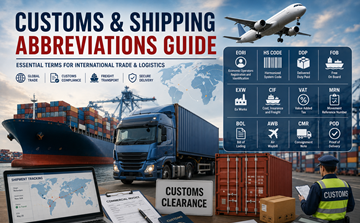
In this guide, we explain the most important customs and shipping abbreviations used in European and international trade, including customs declarations, Incoterms, export documentation, freight transport, and import-export logistics operations.
What Are Customs and Shipping Abbreviations?
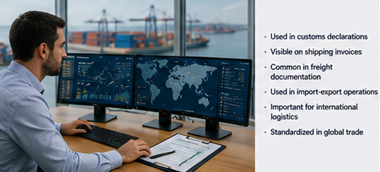
Customs and shipping abbreviations are shortened terms used in international trade, freight transport, export-import operations, customs declarations, and shipping documentation. These abbreviations standardize communication across countries, ports, warehouses, freight forwarders, and customs authorities.
- Used in customs declarations
- Visible on shipping invoices
- Common in freight documentation
- Used in import-export operations
- Important for international logistics
- Standardized in global trade
EORI and Customs Registration Abbreviations
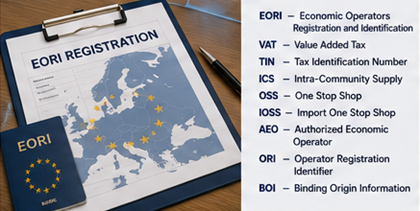
Businesses involved in import and export operations within Europe often require customs registration numbers and identification systems.
- EORI — Economic Operators Registration and Identification
- VAT — Value Added Tax
- TIN — Tax Identification Number
- EIN — Employer Identification Number
- ICS — Intra-Community Supply
- OSS — One Stop Shop VAT System
- IOSS — Import One Stop Shop
- AEO — Authorized Economic Operator
- ORI — Operator Registration Identifier
- BOI — Binding Origin Information
These abbreviations are commonly used during customs clearance, VAT reporting, and international shipping operations across Europe.
HS Code and Product Classification Terms
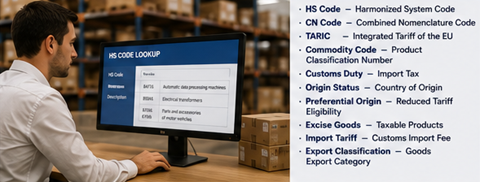
International trade uses standardized product classification systems to identify goods and calculate customs duties and taxes.
- HS Code — Harmonized System Code
- CN Code — Combined Nomenclature Code
- TARIC — Integrated Tariff of the European Union
- Commodity Code — Product Classification Number
- Customs Duty — Import Tax
- Origin Status — Product Manufacturing Country
- Preferential Origin — Reduced Customs Tariff Eligibility
- Excise Goods — Taxable Special Products
- Import Tariff — Customs Import Fee
- Export Classification — Goods Export Category
Correct product classification is essential because customs duties, restrictions, and VAT rates often depend on the HS code assigned to goods.
Incoterms and International Shipping Abbreviations
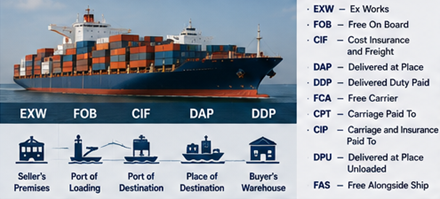
Incoterms are internationally recognized trade rules defining responsibilities between buyers and sellers during shipping and transport operations.
- EXW — Ex Works
- FOB — Free On Board
- CIF — Cost Insurance and Freight
- DAP — Delivered at Place
- DDP — Delivered Duty Paid
- FCA — Free Carrier
- CPT — Carriage Paid To
- CIP — Carriage and Insurance Paid To
- DPU — Delivered at Place Unloaded
- FAS — Free Alongside Ship
Incoterms determine who is responsible for transport costs, insurance, customs duties, and cargo risks during international shipping.
Customs Clearance and Border Abbreviations
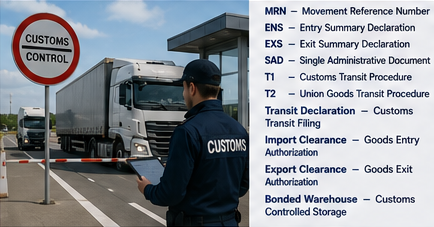
Customs authorities and logistics companies use many abbreviations during border inspections and cargo clearance procedures.
- MRN — Movement Reference Number
- ENS — Entry Summary Declaration
- EXS — Exit Summary Declaration
- SAD — Single Administrative Document
- T1 — Customs Transit Procedure
- T2 — Union Goods Transit Procedure
- Transit Declaration — Customs Transit Filing
- Import Clearance — Goods Entry Authorization
- Export Clearance — Goods Exit Authorization
- Bonded Warehouse — Customs Controlled Storage
These customs procedures help governments monitor imports, exports, duties, and international cargo movement.
Shipping and Freight Documentation Abbreviations
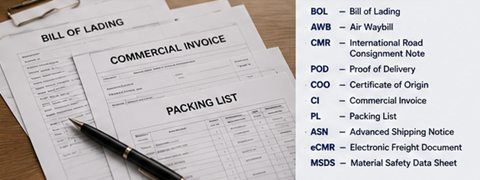
International shipping requires many transport and freight documents containing standardized abbreviations.
- BOL — Bill of Lading
- AWB — Air Waybill
- CMR — International Road Consignment Note
- POD — Proof of Delivery
- COO — Certificate of Origin
- CI — Commercial Invoice
- PL — Packing List
- ASN — Advanced Shipping Notice
- eCMR — Electronic Freight Document
- MSDS — Material Safety Data Sheet
Shipping documents provide information about cargo ownership, transport details, customs classification, and delivery instructions.
Container Shipping and Maritime Abbreviations
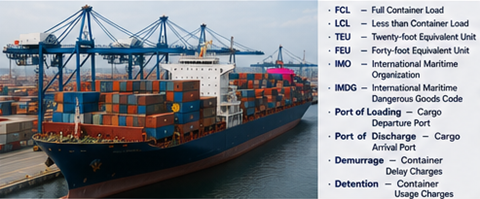
Sea freight and container shipping use specialized abbreviations related to ports, containers, and maritime cargo operations.
- FCL — Full Container Load
- LCL — Less than Container Load
- TEU — Twenty-foot Equivalent Unit
- FEU — Forty-foot Equivalent Unit
- IMO — International Maritime Organization
- IMDG — International Maritime Dangerous Goods Code
- Port of Loading — Cargo Departure Port
- Port of Discharge — Cargo Arrival Port
- Demurrage — Container Delay Charges
- Detention — Container Usage Charges
Maritime abbreviations are commonly used by shipping lines, ports, freight forwarders, and customs authorities.
Air Cargo and International Freight Abbreviations
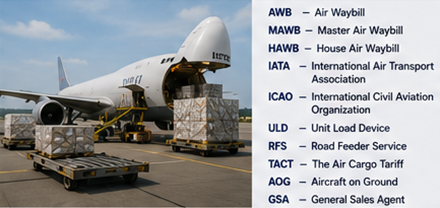
Air freight transport uses many abbreviations related to aviation logistics and cargo operations.
- AWB — Air Waybill
- MAWB — Master Air Waybill
- HAWB — House Air Waybill
- IATA — International Air Transport Association
- ICAO — International Civil Aviation Organization
- ULD — Unit Load Device
- RFS — Road Feeder Service
- TACT — The Air Cargo Tariff
- AOG — Aircraft on Ground
- GSA — General Sales Agent
Air cargo abbreviations help airlines, freight forwarders, customs brokers, and logistics companies coordinate global freight shipments.
How International Shipping and Customs Operations Work
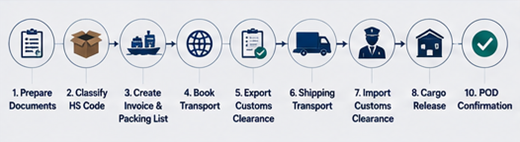
International logistics operations involve multiple stages from export preparation to final cargo delivery.
- Exporter prepares shipping and customs documents
- Products receive HS code classification
- Commercial invoice and packing list are created
- Carrier or freight forwarder books transport
- Cargo passes export customs clearance
- International shipping or freight transport begins
- Import customs procedures are completed
- Duties and VAT are calculated if required
- Cargo is released for delivery
- POD delivery confirmation is completed
Modern customs and shipping systems rely heavily on electronic documentation, digital customs declarations, and automated logistics platforms.
Customs Compliance and Trade Security Abbreviations
International trade and customs operations also use abbreviations related to compliance, inspections, and cargo security procedures.
- AEO — Authorized Economic Operator
- CTPAT — Customs Trade Partnership Against Terrorism
- ISO — International Organization for Standardization
- Inspection Certificate — Cargo Verification Document
- Trade Compliance — Regulatory Shipping Procedures
- Sanctions Screening — Restricted Trade Verification
- Export License — Government Shipping Authorization
- Dual-Use Goods — Controlled Product Category
- Restricted Cargo — Regulated Shipment Type
- Customs Audit — Trade Compliance Inspection
Compliance procedures help ensure legal international trade operations and secure cargo movement across borders.
Conclusion
Customs and shipping abbreviations are essential for international trade and global logistics operations. Terms such as EORI, HS Code, DDP, FOB, MRN, AWB, and POD simplify communication and standardize shipping procedures across countries and transport modes.
Understanding these abbreviations helps businesses manage customs clearance, freight transport, import-export documentation, and international logistics more efficiently.
FAQ
What does EORI mean?
EORI stands for Economic Operators Registration and Identification number used for customs operations in Europe.
What is an HS code?
HS code is an international product classification number used to calculate customs duties and taxes.
What does DDP mean in shipping?
DDP means Delivered Duty Paid where the seller is responsible for transport costs, customs duties, and delivery.
What is FOB in international trade?
FOB means Free On Board and defines shipping responsibility transfer at the port of loading.
What is MRN in customs clearance?
MRN stands for Movement Reference Number used to track customs declarations and transit procedures.
What is the difference between FCL and LCL?
FCL means Full Container Load while LCL means Less than Container Load where cargo is shared between shipments.
Why are shipping abbreviations important?
They simplify communication, standardize international trade procedures, and improve logistics efficiency.
What does AWB mean in air freight?
AWB stands for Air Waybill which is the transport document used in air cargo shipping.
eXus Dev